It is funny and exciting where this whirl of events called life leads us...
This morning I decided to pick up some theological reading, Introduction to Christianity by Joey Ratzinger, to start my day off with some profundity. I began with some hesitation, or actually before I even began reading I started to doubt my selection. When one has in their grasp, oh say twelve books, that one has begun, perhaps read a chapter or two, and then set down for that distant "later" of attention and reflection... well, it can be tough to step back into that shadow of wisdom.
Anyway, I picked this vintage Theology 101 required text up on page 68 or so and what would you know, I entered into a discussion on the single most personally important topic of the last couple years of my life: faith and trust.
Ratzinger was talking about three basic movements in the history of human thinking: the earlier period of contemplation of the eternal, the brief historical period where metaphysical truth became manifest in "facts" and events from the past, to the contemporary (I guess this is called modernity) period of "techne" or as Ratzinger says "makeability". According to Ratzinger it is a mistake to adopt wholesale any one of these positions (duh), however in laying all three out he makes some interesting observations. For one, the brief historical period where myth became meaning allowed Christian belief a short-lived victory: finally the "grand truth" of Christianity and the adventure of Jesus was brought down from el cielo, the heavens, and put in its proper context in the physical life of our planet. Unfortunately, or perhaps fortunately as we'll see in a moment, the epoch of history was quickly overtaken by the time of "techne" where woman became less concerned with what is, and more and more keen on exploring and experimenting with what could be. [Hence, bombs, buildings, medicine, and dog food.] SO, we land in a time when recollection is all the more necessary: we must remember the dual facts of is-ness, the glory of what abides in this world, and also potentiality and what we can make of the world. We will not be mere custodians of the past, wiping dust off the relics and realities of old and longing for a story of our own; nor should we be merely future-oriented, trudging forward ever forward without learning the language of self, the art of reflection, and the joy of being.
Well, that's my take on it anyway. Getting back to the trust and faith stuff, Ratzinger said this statement, which I opine to be a bodaciously potent idea: (with regard to Christian belief) "Essentially, it is entrusting oneself to that which has not been made by oneself and never could be made and which precisely in this way supports and makes possible all our making" (p. 70).
Ok, way to bring together 3 movements in the history of thought with one existential and spiritually relevant conception of trust.
What most caught my eye were the words "not been made by oneself". Belief is trusting that which has not been made by oneself. I recall a passage or 1392 from the Dalai Lama's "How to Practice", and Bhante Gunaratana's "Mindfulness in Plain English". A lot of the writings I have reviewed containing Buddhist content seem to speak a lot about an idea of selflessness which extends beyond the commonplace idea of being kind or generous. What amazed me first about Buddhist ideas is their profoundly delicate manner of critiquing down into the human consciousness to lift out facts of celestial significance. Here, in relation to Ratzinger's text on belief, I think we have an example of just that phenomenon of immersion-up understanding.
According to the Dalai Lama, "The fundamental cause of suffering is ignorance- the mistaken apprehension that living beings and objects inherently exist" (p. 138). Now aside from the whole suffering deal in Buddhism - ok we cannot merely say "aside from" that deal, because it happens to be, as far as I can tell, pretty central. And I suppose I believe that one who rids them"self" of suffering must necessarily be acting to remove suffering from all "selves", and more pertinently, from the negative energy of hate in the world, but... This is too much to take on right now.
Instead, I'll just reiterate the part about the mistaken apprehension that living beings and objects inherently exist.
That is, I exist, and have every right to say such silly things as "why yes, I exist". However, the sub- or unconscious assumptions that often run in parallel with such identity affirmation are in fact false (so says senor Dalai Lama). For instance, I exist in respect to my immediate experience of consciousness in the world. However, the idea of an I, of me, of an Alex that is a separate or sealed-off being in the world is false. "I" refers neither to my mind, nor to my body, nor to some other "higher" faculty of spirit or consciousness; rather, "I" is a miraculous conception of the mind which allows me to make some sense of the small slice of [Yahweh] which I've been given to tend.
Ah-hah! So "I" puts me in contact with the slice of being which I, quite confusingly at present, inhabit. Yet it does not represent any real definition of character or being. Rather "I" is a confluence of events whose continuance and history is only artificially cut-off from all other beings when I say "I am Alex" as opposed to the rest of the world. Furthermore, and here's the kicker and the meaning of inherent existence brought to light: I did not make myself. I did not set my'self' up in this world. haha, "I" am just here!
And what better way to live than to celebrate this presence of an "I" which I have not created, which simply abides, and to recognize its intimate connection with all that is possible. And here we loop around to Ratzinger: If I entrust myself, as Ratzinger says, to "that which has not been made by oneself", I am merely standing in what the Dalai Lama might call a state of enlightenment. And furthermore, if I recognize the connection of that which is with the process of making that which will be... Well, then I think I've understood a basic definition of karma as action. That is to say, actions have consequences.
Now if you are still reading this, I'll give you the part I like best: Ratzinger gives me a Christian understanding of faith. An understanding based in the metaphors of God and Jesus. And he even plunges deep into the "what the heck does this have to do with life on earth?" question by citing real experiences and linguistic developments in society and the biblical tradition. That is, he shows that what the Hebrew text wants to say about faith is just what the Buddhists as far as I can tell want to say about faith, and is just what Ratzinger ends up summarizing about faith, and that which all human beings can comprehend without knowing: "Faith is trusting God, the all, the root of all".
AND the Dalai Lama tells me what this means existentially (and we all know how important the existential questions are to Alex). He says something like: "reflection will show us how flawed and commonplace a belief in one's inherent existence really is. "I" do not exist in the way "I" believe; rather I use this identity Alex to make sense of the slice of God I have been given- mind, conciousness, feeling- which only appears to be cut-off from the rest. I use this identity Alex to take care of and unite with the broader "I" in others- feelings, relation, presence. Therefore, I am in fact my relationships, not "Alex" the one of many. I am Alex in relationship with all beings, as an active organ of the Being that some call God.
Hence, a quote my wise friend Ariel shared with me from Santa Teresa de Avila:
Christ has no body now but yours
No hands, no feet on earth but yours
Yours are the eyes through which He looks compassion on this world
Christ has no body now on earth but yours
Oh, I equivocated. This is my favorite part:
A simple difference in approach to Being I've noticed: Alicia, for instance, glories in being. She enjoys it and that is not to say she is passive in it; rather she is more than anyone I know in the flow of being, seeking to remain faithful to its interdependence and capacity for connection, and joying in the warmth this nest of being offers, even when things are cold.
I, on the other hand, "Alex", want to understand more than anything. I have always wanted to understand, and it has often lead me to despair. For I have not balanced well always the need to simply stand sometimes. Stand with others in this Being, let the spontaneous connections play and jubilate, and don't bother too much to reign it all in for inspection. This, if you follow me, is what I have been doing in Suchitoto, El Salvador, and what I have been learning to do all my life. I have been letting my true identity out to play. In yoga classes, in conversations with friendly strangers and strangely frienders, and in quiet moments of prayer in which I feel God holding all. Trusting this holding is the belief I think Ratzinger speaks of, as opposed to understanding it necessarily, or even ignoring it and focusing instead on what can be done with all this stuff.
That said, I'm going to go play. If at any point I gave the impression that I know what I am talking about, haha, that is because I was trying to give that impression. Have a great day, peace!
Tuesday, December 21, 2010

Sunday, December 12, 2010
Daze Learning
"Where have I been lately?" I ask myself. I don't feel quite here. I often feel distant or distracted. Present to many people and processes to be sure, but at the same time preoccupied by some unseen thought. What is it, this blank force, that steals my attention?
On one hand lots of "stuff" is going on. The other volunteers and I just held our end-of-the-year concert last weekend to celebrate the completion of our various talleres, or workshops. The kids' harp group performed to kick things off, then Ariel's children's chorus joined with the harps to play a pair of beautiful Christmas songs. Two brilliant poets from my poesia class performed solo before a packed house of aobut 100 people or so in the Center's cathedral. And then the adult choir took the stage to sing "Dona Nobis Pacem" and "Capilla Celestial" before joining with Paul's guitar class and the children singers for the grand finale, "Somos el mundo". (A video is out there somewhere, I'll have to track it down...).
It was such a special night. As fledgling as our efforts are here in Suchi, the mere commencement of a celebratory movement of art amongst Suchitoto youth is exciting and important. I am proud of all of our students for stepping into uncharted territory (just ask Ariel- singing in scale and semblance is way unexplored land for these kids), and of my fellow volunteers as well for putting so much positive energy into making it happen.
One especially potent image from the night for me was seeing Delmy, one of our office-mates at the Center, behold her lovely son Cesar playing lead harp with the rest of the harpists. Her reserved joy and hand-clenching anticipation recalled to me the nervousness of my dad at one of my brother Chris' figure skating competitions. What love is expressed in such anxious witnessing. To behold part of your very own heart performing the magic of their soul in front of so many others...
Apart from the immense preparation for the concert, the volunteer team has been living "as usual". We are unfortunately without our beloved Christy, who is at home now with her family to accompany them (and be accompanied in return) through a difficult familial reality. Our prayers go out to her, and our trust in her loving nature.
So computer and English classes go on, as do long days spent half-babysitting, half regressing to childhood, in our skatepark. We eat some meals together, have community skate sessions, and attend to the various needs of the Center and our various communities. Speaking of which, I just cannot spend enough time out in my campo home with my brothers and abuelita. But I did have the chance to watch a movie with Chomingo (my older "campo brother") a couple nights ago.
This was a great time. Even though the movie was an excessively violent Guy Richie film (called "Rock'n Rolla" I believe), it was good bonding time for Chomi and I. Huddled alongside him in front of David's mini laptop, sitting in our cold campo patio in the night, I felt a certain lax proximity with Chomingo and my El Bario home that I just don't think I could get without doing "frivolous" things like watching movies. I also recall with nostalgia the of hours of fun wrapped in blankets in front of a Disney Classic, Discovery Channel special, or any one of the old Star Wars VHS's with my siblings: beach towel spread across the low, wooden coffee table to receive steaming hot Pizza Hut pizza boxes, and absorb errant swigs of root beer or ginger ale. Ah the joys of the big screen....
So Big Change is happening in life. I think part of my distance, which by the way is fading interestlingly enough as I probe deeper in thought, is due to the sheer stress inherent in changing environments. All semester I've been moving- from the Center out to El Bario, then to Antiguo Cuscatlan to visit Alicia every other weekend or so, and as far as Honduras to take a few days' vacation- and now the move home for Christmas is upon me. I packed up my El Bario home last Thursday, we held our last Yoga class for the year, and all the volunteers and Peggy saw Ariel off until January. Fortunately we were able to get a skating sesh in before her departure. The picture below is from last week's session...
That was great fun (Dad and Will: I can't WAIT to play hockey when I get home!).
One thing I notice: the more I realize how close my return home to the States is, the more I cherish and long for the relationships I've developed here. With my volunteer team and Peggy; with my extraordinary campo brothers, Chomingo the artist and David the prophet, and their grandmother, "La ingeniera" (the engineer). With the members of my yoga class, Luis Felipe especially, as well as all the young and old folks we know around town with whom I could spend whole days just hanging out and getting to know. With Nina Candalaria, Gladys, Nina Cruz, Nico's family, all from El Bario; Margarita in the mercado, and all the other sacred Salvadoran women who share with me their most intimate memories and joys. Heck, the vigilantes at the Center, the first Salvadorans and the first guys I befriended here in Suchitoto... Thank God I will be seeing everyone again in January. Primero Dios.
It is a mirror-effect then, and I am doubly grateful for the relationships I'll be entering back into in the States. A month at home appears to me as a wide open window in which I am invited to re-enter parts of my home-identity, share in the changes in life I and my family have seen, and exuberate in the glory of winter. To breathe cold air in my nostrils once again- oh, and to drink-in the snow-cold humidity of an enclosed hockey arena....
All these reflections save me from the mounting cloud of confusion I've been feeling in my forehead. The confusion of the future stubbornly begs my attention: a pending job application that vacillates in my heart between being the single most important thing ever, hanging in front of me to decide the rest of my future... and later settling down into the truth of a mere possible step on a blessed and insoluble journey. The confusion of the present: I'm headed home this week, I just returned back to Suchitoto from Alicia's program's despedida or goodbye ceremony this morning in the capital, and not to mention- crap, Salvadoran reality is freaking rough!
I think part of my stress is due just to receiving so many sad stories over the past weeks. I barely flinch when I hear a woman who is innocent and old tell me about the 3 children she lost in the war, or when a man who is old and charming shows me the 3 bullet wounds he received from U.S. guns while trying to protect his people's meager livelihoods. Puchica, it certainly makes an impression on me, but sometimes I feel like I've just checked-out of the world, despite being engaged and taking some things in.
One way I think I've expressed this phenomenon is using speaking a foreign language as a comparison. I feel sometimes as though not only the words are of a different tongue, but also that the experiences themselves are sewn of a strange and scary fabric that just does not allow people's experiences to land anywhere fertile in my brain. Rather, stories of the war and current hardship just clobber down against hard areas of my mind that don't want to accept suffering, injustice, and most of all cruel design, as components of the world I love. And hard parts which furthermore don't understand what it means for these unfortunate things to go on existing anyway.
Is this me not being able to relate personally to the people I am living with? Certainly that must be part of it, for my experience of life is so different... Is my "daze" also the accumulation of some truly stressful life events like moving around and living in a foreign country, and planning on returning home soon? I think so...
I think I am also just getting closer and closer, despite feeling shell-shockedly distant sometimes, to the frequently stated fact that "estamos jodidos" (more or less: we are screwed). I wish for every "es un perro" (life's a *$*%#), "asi es" (that's how it is), "la lucha siempre sigue" (the struggle always continues), or estamos jodidos I heard, a son, or daughter, or mother or father could rize from the grave. It's just not the way I'm used to concluding things: estamos jodidos. I'm used to thinking that sometimes I suppose, heck in my darker times I'm used to feeling that. But it's always been a thought or feeling accompanied by something more, a promise or vague intimation of a future that could still yield good unions. And this is not to say that I'm losing hope in such a reality, nor that the Salvadorans I've been speaking with are doing so either. Rather, faced with the bold expression that "we are screwed" emanating from the lips of people who seem to be pretty good authorities on the ups and downs the gamut of life has to offer, my perspective is changing. My idea of what it means to be human in this world, and to live a life of intimate hurt and small lustrous joys, is changing radically.
I don't think I'm "jodido". And I think half the reason some people say they are comes from a legitimate need to relate or give expression to an un-utterable dimension of suffering. The loss of a part of your family, a part of your body, a part of your human nation. I guess I'm coming up uncomfortably close to the question: "How do I invest in a world that breaks my heart?" Because it truly does. How do I keep finding energy to love the rebirth in every moment, and to love the people who form us, amidst so much death in the hearts of people I know and love? ...And it is not only people from El Salvador I have in mind...
I picture my friend and neighbor Nina Cruz's face after telling a story of recurring nightmares last week. She is sitting on a red plastic chair looking ahead, her one arm perched on her side as she hunches slightly forward. She's not staring, but her eyes are fixed intently, and tiredly, on something far far inside... It is like seeing the aftermath of a forest fire. Or a land-roving human fire. Large chunks of human fleshy being have been mangled and disintegrated to the ground, and Nina Cruz sits. She is not mad anymore, for the fire is out. Instead she just sits. Among the ashes.
I cannot wait to see my family this week. And I cannot wait to see Alicia on Thursday. And I cannot wait to see Korla, Paul, and Cassandra, the other volunteers, and Sister Peggy tonight... I cannot wait to see Nina Cruz again, possibly this evening, and David and Chomingo, and my El Bario neighbors... I cannot wait to see Wiliam the friendly vigilante at the Casa program, and to give him a mini soccer set I received when I bought my cell phone months ago... I cannot wait because these are the people with whom we stand amongst the ashes. The people from whom I receive the love to share with people and myself when we are down, when there is nothing for us to do but to be there with each other in the aftermath.
It is what we do in the aftermath, says Father Mark Ravizza, that truly matters. It is what we do together, with what we've got amongst ourselves, that counts. After all, it is what I do in El Bario, and what El Bario-ans do in El Bario, and what Nina Cruz and her family do with what we've got, that determines our present, our reality, and our future... Shoot I don't mean to pull everything together happily at the end here, but I am darn happy to be standing in this world amongst so many worthy, loving, deserving, and generous-capable people...
How to love in a broken world, "how to live out of the truest place within", says my friend Grace. This is what I look to my family and friends to help teach me... And I bow to all those finding out.
Peace!
Tuesday, November 30, 2010
The warmth of presence
 Well it has been a busy past couple of weeks. Although I have written a couple of reflections I have not had a chance to publish any blogs, but today I want to at least express a couple of things. It is going to be somewhat disjointed, but I hope you enjoy the following snippets.
For one, as busy as the last couple weeks have been, it has been an excellent time of growth and opportunity. We started computer and English classes two weeks ago to take advantage of the kids' vacation time. During the school year they won't have as much time to come to the Center, so almost every volunteer has either a computer class, an English class, or both. Korla for instance has computer class almost every minute of the day as far as I can tell, and also manages to lead an English conversation class. I am still giving Yoga classes twice weekly, and a few poetry students, so I have taken on biweekly English conversation and computer classes.
One of my computacion students, Rosa, has been a joy and a struggle to work with. She is only 13 years old but, as I discovered in a moment of truly horrifying reality, she is nevertheless victim to the cat-calling harassment of men two and three times her age. Well, Rosa has little confidence in her abilities as a computer student. After our third class she told me she wouldn't come anymore and vaguely indicated that it had something to do with having 'pena' (fear or shame) around the boys in the class.
I was pretty firm with her. At first the explanation for Rosa's desire to drop-out consisted only of the exclamation, "porque no!" (it's just... no!) and an embarrassed aversion of attention. I patiently insisted that we talk about whatever her predicament was in order to find out how we could make the environment feel safer. And I told her that it wasn't fair for her to drop the class since there is a whole list of students who would have taken advantage of the opportunity had it not been given to her. She was pretty disappointed I wasn't going to just let her go- at least it seemed that way to me at the time. So I asked her if she thought I was mean. She said no, and told me timidly that she'd see me next class.
Well next class came around and little miss Rosa had a present for me. She approached me shyly- actually she lured me outside the center so nobody could see the exchange- and then she gave me a stuffed, whistling gorilla wearing red sunglasses. I was touched. Rose had really appreciated my thoughtful- but firm- attention. After a conversation that must have been pretty difficult for her, and which did not convince me she was even going to come back, Rosa returned with a sincere expression of thanks.

This past weekend was full of life. Alicia's sister, cousin and friend were in town for Thanksgiving, so I visited the gang in the capital on Friday, and then we all came back to Suchitoto on Saturday. The whole weekend was fantastic. I got to play tour guide and translater, we had reflections with Alicia's praxis site in the capital, we went on a way-too-long excursion in my campo community to a river, to eat sugar cane, and to visit an indigenous cave... AND our generous visitors treated us to the nicest hotel room I have ever seen (with a fantastic view of Lake Suchitlan). Eileen, Beth, Brian, if you are readying this, I echo the words of all our Salvadoran hosts: thank you for your presence!
 Yesterday Korla and I spent the morning out in El Bario picking up trash in the first-ever trash collection in El Bario. Just imagine that: it's 2010 and the funds and motivation to remove garbage from homes is just finding its way into the community. I am no expert on economy, civil war, or the contemporary climate of social progress in El Salvador, but I'd say that fact can serve as part of a powerful snapshot of where many Salvadorans stand- socially, environmentally, psychologically...
I finally received a postcard and package that my mom sent probably weeks ago. (THANK YOU MOM!). In the package was a Philadelphia Art Museum postcard with a BEAUTIFUL poem, several fancy soaps I would never buy for myself but will certainly use, and a present for my campo abuelita. This present, as I'm sure my mother intended, was the best, most life-giving part.
My mom had sent along an aquamarine pashmina scarf for Dona Carmen, thus demonstrating my mother's instinctual ability to discern (without background research as far as I can tell) just what a particular person in a particular physical and emotional space could use. And my mom enclosed a note which, much to my delight, she intended for me to translate for my abuelita.
In the note was a beautiful poem about warmth and care. It expressed gratitude to Dona Carmen for hosting me and sharing with me so much love. You should have seen abuelita... She was genuinely shocked at the gesture, which lasted only moments before she welled up with good ol' fashion Salvadoran excitement and thanks.
She threw the scarf right on with minor assistance from me, and then just kept saying, "Que chula!" (how cute!). After reading her the note from my mom she asked if I could show her a picture of my mother sometime, so instead of delaying I grabbed my family pictures from my room and showed her a couple right away. "Bien joven!" she said, "how young!".
I then asked Abuelita if she wanted to say a couple words to my mom in a video. And this is where you'll just have to witness to believe the power of abuelita's love...
Me: Decirle algunas palabras
Abuelita: hm? Y que le puedo decir alli?
Me: Es un video, usted puede decir algunas palabras para mandar a mi madre
A: Le mando miles de saludos- miles de saludos. Y que la felicito, que aqui tengo su hijo. Y es bien portado, cabal. Educado, y galan.
Me: Como usted.
A: Que la felicito digale.
...La mama verdad? es un tesoro... Y que yo estoy alegre porque aqui lo tengo. Eso. Bien bonito, va. Mire?
(my translation:)
Me: Say a few words to her
Abuelita: Hm? … How do I do that with the camera?
Me: It’s a video. You can say some words on it to send to my mother.
A: I send her my love (literally: thousands of warm greetings). And congratulations and thanks to her, for I have her son with me here. And he is well-refined. Educated and gallant.
Me: just like you…
A: Tell her that I congratulate and thank her.
A: Ahh your mother… What a treasure it is to have a mother who loves… And I’m happy because I have you here. Yes!
(admiring the scarf): how beautiful, do you see? Look?
Thank you for taking the time to share... Have a great day.
Tuesday, November 9, 2010
What is holy
The soundtrack to this post is Ray Lamontagne - Hold You in my Arms. If you have a few quiet moments, it would be better to sit down and listen to this song before or while reading these words...
So in case I haven't said it explicitly up til now, I am living in the countryside of El Salvador, outside of the city of Suchitoto. The name of my community is El Bario. It is a poor rural community full of trash because there is no collection service, and full of smiles and "que le vaya biens" because there is no other richer resource in El Bario than humans and humanism.
The community has seen some of the harshest days of the civil war that raged in El Salvador through the 80's. Many of El Bario's inhabitants lived previously in a zone called Chaparral which lies further "abajo" (below) present-day El Bario, closer to lake Suchitlan and farther from the main road that runs between Suchitoto and the western rural communities. During the war this zone disbanded, its inhabitants fleeing to the mountains, to Suchitoto Centro, or remaining in their houses to brave the air and foot-soldier raids of the military.
One day David took my friend Guillermo and I for a walk up the rough piedra-filled road up to Chaparral, where we took in corn fields, rice fields, former sites of houses and finally the now defunct community school building of Chaparral. This school lies in the thick dusty jungle that abounds in the region surrounding El Bario. It is now a somewhat haunted place. There is one house down a rough shady path of crunchy leaves lying about 40 meters away, where one imagines the inhabitants are quite old- the hombre probably wears a cowboy hat to the milpa and walks very slowly, he is actually probably living there alone- and still living in the days of the war. Otherwise nothing marks the landscape but the small river that trickles through the woods and the roofless school which was both erected and destroyed by the Salvadoran government.
Toward the end of the war, when the resettlement of Suchitoto slowly began to take place with the aid of church support and individuals like Sister Peggy, El Bario was the first community formed. Erected closer to the road running between Aguilares and Suchitoto, it was organized more close and compact than had been Chaparral, a fact which, along with the urgency and necessity of the war, makes El Bario to the present day a very close-knit community. Not all the inhabitants are from Chaparral of course, but all of them lived on Volcan Guazapa at some point, or in Suchitoto, or in Honduras, fleeing or fighting one way or another.
I live in El Bario with two brothers named David (25) and Juan "Chomingo" Domingo (29), and their abuelita (grandmother) Dona Carmen (80?), all featured in pictures and writing in previous blogs. As Dona Carmen likes to tell me often in her cheerful leather voice: David and Juan were abandoned by their mother (Dona Carmen's daughter) during the war, and left to Dona Carmen to be raised. "Los puse a estudiar", she proudly tells me. She put them to study! "Y usted ha hecho un buen trabajo," I tell her in return. You've done a great job. Your boys are good boys, and they have welcomed me warmly to your wonderful community. Which is very true.
David has taken me for a couple excursions on the mountain side, to the "family" milpa (which is basically just for him and Dona Carmen to pick and eat from), as well as to the site of "Escuelita", another school built and destroyed by the military. (This is another very feo building, very haunted, as it bears the marks of both Guerilla forces and military occupants who held the high-ground of the school in alternation throughout the war. On one wall you see FARN and FMLN right below a military symbol of a Lion, and across from the horrid ATLACATL- the name of the most ruthless and bloodthirsty American-trained death squad in Salvadoran history.)
David has traveled extensively in this world, to Ireland and various other parts of Europe for a year as part of a study-abroad scholarship he was awarded, and again this past year to visit Denmark, Scotland, France, Spain, England and Ireland for another year. His experience traveling and studying economics and culture among other things makes him both incredibly aware of the poor poor reality in which he and his traveled Abuela are living, and also pointedly hopeless. He walks the dirt street of El Bario with "chacos", a num-chuck like armament that he has no doubt used on various angry muts or hostile humans. David has killed things, dogs for sure, maybe more. He speaks powerfully always, he says hello to everyone. Kids from the community come to our house to upload "cool" foreign music from David's laptop onto their phones. (Coldplay and U2 seem to be David's favorites, but he has a lot of different music gathered no doubt from his travels.) My "campo brother" David works for uncles and aunts, friends in the community, doing construction, digging graves, whatever the work may be. And I think he is starting work this week with a govermental education program aimed at ending illiteracy by 2015 in El Salvador.
One of my favorite things about living in El Bario is seeing the relationship between David and his dog, "Forr" (Alcanfor, or sometimes "Afortunado"). According to David, Forr is an Indio dog, a Mayan dog. He is slender brown, with pointy ears and sharp eyes, and he reminds me of Egypt. A couple days ago David was cutting some cow parts apart on the pila (the same stone surface we use to wash plates, clothes, etc.). Every once in a while he would slice off a piece of fat or ligament. "Mira, el no come todo. Es listo. Otros chuchos comerian todo, pero el es listo. El lo va a esconder donde puede encontrar luego."
Forr seizes the piece of fat and gets a good hold of it in his canines. He darts off behind the house, out of sight. "Ahh you're right! He is so smart!" I tell David. A moment later I hear light paw steps on dry leaves toward the front garden. There is Forr, head down, searching out a good spot. He digs a little with his front paws, piece of cow fat still clutched in his slender jaws. This spot's no good, he moves on. "Mira, necesita conseguir un sitio donde no va a descrubrir el Olaf. El sabe. El sabe". Forr needs to find a spot where the neighbor's dog Olaf (Forr's cousin I think) won't find the fat.
Finally he finds a good spot, digs in with his front paws. "Ha-ha ya lo hace!". David's face lights up even more full of cheer. Forr completes the job by replacing the tierra with his snout, and then patters away. David swaggers back to the pila, mini-machete in hand, and cuts back into the carne.
Chomingo is my other campo brother. He is the older of the two, but more reserved, more tranquilo. With David I talk politics and economics, and he gets passionate and a little bitter and then says "oh well, we try and maybe one day". But with Chomingo one experiences pure presence. He is more slender, a little taller, and he wears very worn clothing, long hair and a trucker hat on which he painted a colorful design. Chomingo studies art in the capital so he is gone Sunday through Thursday usually. One must see our home to believe it, but the place is strewn with Chomingo's artwork. A painting of children playing war on one wall. A "navi" mural on the back of the house. A painting of the virgin Mary, plump round breast at the center with baby Jesus in her arms. Further inside, in the room in which I sleep, the walls are painted blue and green, hand prints adorn the upper parts near the terracota-tile ceiling. One knows within a couple minutes of arriving to this house that it is graced with a certain special energy. If you haven't already learned of the heroics of Abuelita raising two toddlers by herself in the mountains during the war, or if you hadn't met the impressive personage of David and wondered what thoughts run through his mind, you'd still, just upon entering into the cement floored covered porch (the living and dining room), that special people live here, all around here...
The abuelita has been sick now for about two weeks. She is still her bright cheerful self with me whenever I am around. (Lately she has taken to calling me "el tesoro", treasure.) "Ya viene el Tesoro! El es galan. Bien educado el," she tells anyone who is around. But with David and Chomingo it is sometimes a different story. She is cranky with them. They hide the coffee because she drinks too much of it. David sleeps up the street at his girlfriend's house (he needs SOME relief from caring for his 'mother'). And Chomingo is just gone a lot of the time, studying and working, or painting murals for people.
The last couple nights there have been a lot of people present in El Bario and in the home of David, Chomingo and Dona Carmen because there was a death in the community. A man who lives just across the street, with whose sons David and Chomingo grew up, running around with their fleeing fighting parents during the war. Don Guillermo is the man's name. He had a "derrame del cerebro", a seizure of some sort, and he spent a night alone in a coma out in the corn field, to be discovered the next day by his family.
So hundreds of people flock to the house at all hours, bringing coffee, cups and sugar, or just their presence to let the family and Don Guillermo know they are important and loved. It is literally a celebration- that is the word used by some- and even the son who arrived from the states yesterday (he is about 24) seemed to be "tranquilo" and well composed.
So yesterday when I arrived home Chomingo stood by the street smoking a cigarrette, huddled into his old leather jacket (record setting lows lately- 65 degrees maybe). We caught up on the day's activities, I told him what was going on at the Center, etc., and then he told me that the abuelita, Dona Carmen, is doing better. I said I was so happy to hear that, and told him how nice it was to see her the past couple nights full of joy at all the visitors eating, hanging out and sleeping over at her home (with a wake comes a sort of community sleep over it seems- friends, family, relatives of whichever person). Chomingo, in his gentle composed manner told me that the "ingeniera" (the engineer they call their grandmother) woke up happy this morning. "Creo que es porque en la noche, como no hay mucho espacio y hizo tanto frio, le pidio lugar en la cama. Le dije permiso," said Chomingo, gesturing with his arm how he had carefully addressed his grandmother as he snuggled in beside her in the bed. There was not much sleeping room for Chomingo in his own house, and it was freezing, so he went to keep his grandmother company, paying her back some perhaps for her years of perseverence and duty. "Y ella amanecio feliz hoy." And she woke up happy today.
Tuesday, November 2, 2010
Metamorphosis

There is no redemption for suffering. The ability to see light in the world does not make rape ok, does not liberate an abused sole from their pain. However, in a world where pain and suffering are inevitable, the ability to transform suffering into life is a vital skill. As much as we might try to isolate ourselves in safe communities, or safe hobbies, diets, and jobs, suffering will always find us: the loss of loved ones, self-doubt, dissatisfaction, and sheer confusion as to why things must happen as they do. As my friend Olivia reflected last week, in the realm of a reality of suffering, it is the ability to turn such suffering into something that gives you life that is the redemptive factor. (in the picture from the left: my "campo brothers" Chomingo and David taking a break from painting a mural for the local radio)
For example, if an individual were to lose a family member, a very close one, and be thrust into a deep depression, where might she find redemption? She cannot bring anyone back to life, nor pretend it does not hurt. The plain fact is a loved one is now gone. In order to find life in such a tragic incident, one must consider their capacity for life and love, and consider the other people affected by such tragedy. For instance, our friend here could recognize the shock-wave of suffering caused by the death of her family member, and seek to bring comfort and love to the others affected. Notice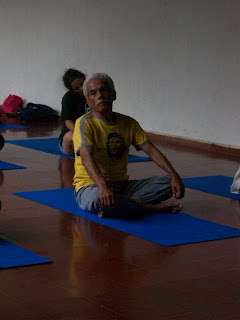 there is nothing special or magical about such a response. It simply takes into consideration the reality facing a given human community and seeks to respond in a manner that integrates suffering into a life that can nevertheless be marked by liberation. Death does not go away, pain and loss continue to be felt. However the human person faced with such difficulty finds new wings in her ability to step forward in community with others and reach toward greater love and greater solidarity.
For example, if an individual were to lose a family member, a very close one, and be thrust into a deep depression, where might she find redemption? She cannot bring anyone back to life, nor pretend it does not hurt. The plain fact is a loved one is now gone. In order to find life in such a tragic incident, one must consider their capacity for life and love, and consider the other people affected by such tragedy. For instance, our friend here could recognize the shock-wave of suffering caused by the death of her family member, and seek to bring comfort and love to the others affected. Notice
 there is nothing special or magical about such a response. It simply takes into consideration the reality facing a given human community and seeks to respond in a manner that integrates suffering into a life that can nevertheless be marked by liberation. Death does not go away, pain and loss continue to be felt. However the human person faced with such difficulty finds new wings in her ability to step forward in community with others and reach toward greater love and greater solidarity.
For those familiar with Father Mark Ravizza's "3 movements", I am more or less referring to the third movement (after the breaking of a heart) where one decides not to retreat from life but instead to invest oneself further, as a whole part of the human community.
(left: Luis Felipe contemplating during a yoga class, and rocking a sweet Che shirt)
These are just some thoughts that are on my mind. Perhaps more to come later.
These are just some thoughts that are on my mind. Perhaps more to come later.
Coming Soon
Hey everyone. So it has been a while since I posted and I have many images and stories to relate. However, since returning from my Honduras/NW El Salvador trip on Sunday I have been quite sick. If you ever travel to central america I would advise you to heed the following advice: DO NOT EAT THE CURTIDO. Curtido, by the way, is the chopped cabbage, pepper and carrot mixture one finds at a pupuseria (restuarante or street vendor that sells the stuffed-tortilla food called pupusas). Now I already knew that the large plastic jars they keep curtido in are pretty unsanitary (the same jar is used over and over again, and if a batch of curtido doesn't go eaten for several weeks, well it just stays in the jar); but I just couldn't resist slopping a little curtido on the old pupusa.
Thank God Alicia didn't eat any... Another bright spot related to my sickness is simply that it is a very humbling experience. To live several days where one is so tired and sick that resting and doing the basic duties of living is the sole objective is a pretty enlightening experience. In order to take care of our wider life in humanity on this planet, we need also and from the beginning to take care of ourselves. So goodbye curtido, my strange semi-pickled friend.
Coming soon:
-pictures and stories from the ruins at Copan, Honduras
-reflection on spirituality and the movie No Country for Old Men
For now, I am going to make some pasta and watch "Donde viven los monstruos", or Where the Wild Things Are.
Love,
Alex
Sunday, October 17, 2010
Un-utterable
 Nietzsche, in the fourth book of his "Joyful Science", says something like "with the first breath of spring I want to sing my dearest wish: that I can ever more learn to see as beautiful that which is necessary in things". I awoke Friday morning with this idea perculating in my mind. The haunting depths of Nietzsche's nihilism were lurking as always with the awe-inspiring beauty I see in his tragically un-realized philosophy of inspiration and life. Yet on Friday I felt more confidence in the accompanying feelings of trust and forgiveness, and I had the sense the latter two sentiments really could raise Nietzsche's broken words to life, especially in a place like El Salvador.
My thoughts Friday morning have helped me to begin to articulate something I've been struggling and desiring to articulate since arriving in El Salvador: my reason for being here. I think in a country that has seen so much suffering, so much degradation and violation of human dignity, and that continues to suffer under an unjust and unredeemable world-economic system- In a country where neighbors have slayed neighbors, and neighboring countries have been invited to join- life would be impossible if it were not for forgiveness. The average Salvadoran campesino would die of rage and injustice. The green dusty mountains would shrivel in the heat and the only drops of water left running would be in the blood of all the innocent women, children, men, and human life destroyed in the unthinkable processes of betrayel we call "war", "politics", "ignorance", and "fear".
Fortunately for El Salvador, fortunately for the human soul, there is a capacity for forgiveness. And it runs rampant in El Salvador. In fact I think there are elements in the Salvadoran landscape and manner of family life that tacitly and persistently preach the necessity and truth of forgiveness. (Talk about learning to see as beautiful that which is necessary- that your country suffers from centures of polarized economics, gang violence, and the daggers of hunger and poverty.)
 Well, as horrible a picture as I may paint of El Salvador or the world, when I am here I come into contact with the deepest sense of peace I have ever experienced. To be accepted by my host family- my abuela, David, and Chomingo- to be embraced by the kids of Barrio San Jose in the immediate environs of the Center- to share the sacred space we create in a session of yoga. To be welcomed by Salvadoran smiles, to be invited every single day to learn something new- a personal story, a history, a Spanish word- I feel as if the evil and corruption in me as a fellow bearer of the human form living in the world, is totally forgiven.
Of course I do not always feel this way- inspired, happy, full of peace. There are times when I am dirty and tired and downright uncertain where my mind is. But every day when I wake up I am in love with a world that can see so much pain and tragedy and still give me green and sunshine and my abuelita's "Como amanecio papita!?", and the opportunity to build a class, a community, a movement here with the people of Suchitoto.
Puchica. With all that said, the moment of the week which I wanted to mention surrounds my very lovely abuelita, Dona Carmen, the grandmother of David and Chomingo. (Although first I'll mention, partly for the sake of my own memory, that the abovementioned epiphany comes largely from Dean Brackley's "The Call to Discernment in Troubled Times" where he talks about the liberating experiencing of living with and working with our world's poor.)

Ok, so Thursday night I believe it was. I returned home from Yoga class and chorus with Sister Peggy (she gave me a ride out to the countryside) thinking I would grab a small dinner at the most reputable and clean-looking pupusaria I could find in El Bario. (My first night eating in the campo was followed by a morning in the hole-in-the-ground outhouse.) Dona Carmen had been making cheese earlier in the day before I took off for the Center and I remember thinking "there's no way I am going to eat that" (cheese was one of the culprits, I believe, for my initial ailment).

 Anyway, I got home from class and I was just so inspired from the day. David had taken me for a tour through El Bario's mountains, sites of battle, farmlands with beautiful views of the lake and mountains, and we had capped it off with a fresh-from-the-farm vegetable soup; the yoga class had gone well as usual and I hadn't even prepared much for this one; I was just generally feeling spirited, so when abuelita offered me cheese and tortillas (both homemade) I said "sure, why not".
Well it was just such a special dinner. David and our neighbour Rene took off on some errand or another so it was just Dona Carmen and I. I made sure that she would be eating with me, because I think at first she just wanted to provide me with food, and then we sat down together. I asked Dona Carmen if she wanted to pray, "hacer una gracia", before we ate, and her response was priceless. I don't know if I'm correct in saying so, but it seemed as if maybe no one had asked her to sit down to a real, formal meal with grace and everything in quite some time.
Well we sat and ate, we talked about the day, about Abuelita's husband Antonio (who I do not believe is still alive), about how abuelita lost most of her eye to a tree branch during the war, and I told her all about my wonderful "novia", Alicia, who was going to be visiting us on Saturday. After dinner I shared the many pictures of my family and friends I had brought, introducing my parents and siblings, my girlfriend and cousins, and she must have asked me 10 times who was who everytime I showed her a picture with long-haired me and Alicia.
Ahh. I cannot articulate the words.... Well Alicia has come and gone by now, and the other volunteers and I are getting ready to meet for a spirituality night tonight with Sister Peggy. After seeing Alicia and introducing her to my various friends and family here, my mind is full of thoughts of the future, and thoughts of all the projects I want to enact in El Bario. Before deciding to return to the Center to blog, it was great to spend a few quiet moments looking out over the mountains and lake here and determining myself to stay in the moment and love the people to whom I've been given to love. That means: poetry classes tomorrow, yoga class Tuesday, and a meeting with community members in El Bario Tuesday to see if I can't start some kind of class or activity out in El Bario. Oh yea, and also seeing Alicia Friday for another visit to our friends in Tepecoyo (our previous service site from 2009).
Final thought: "Love has no ugly underbelly. Go to a big space and let out all your spite and anger. Then you will return to the first movement of love to which your soul aspires."

Peace.
Alex
Subscribe to:
Posts (Atom)